
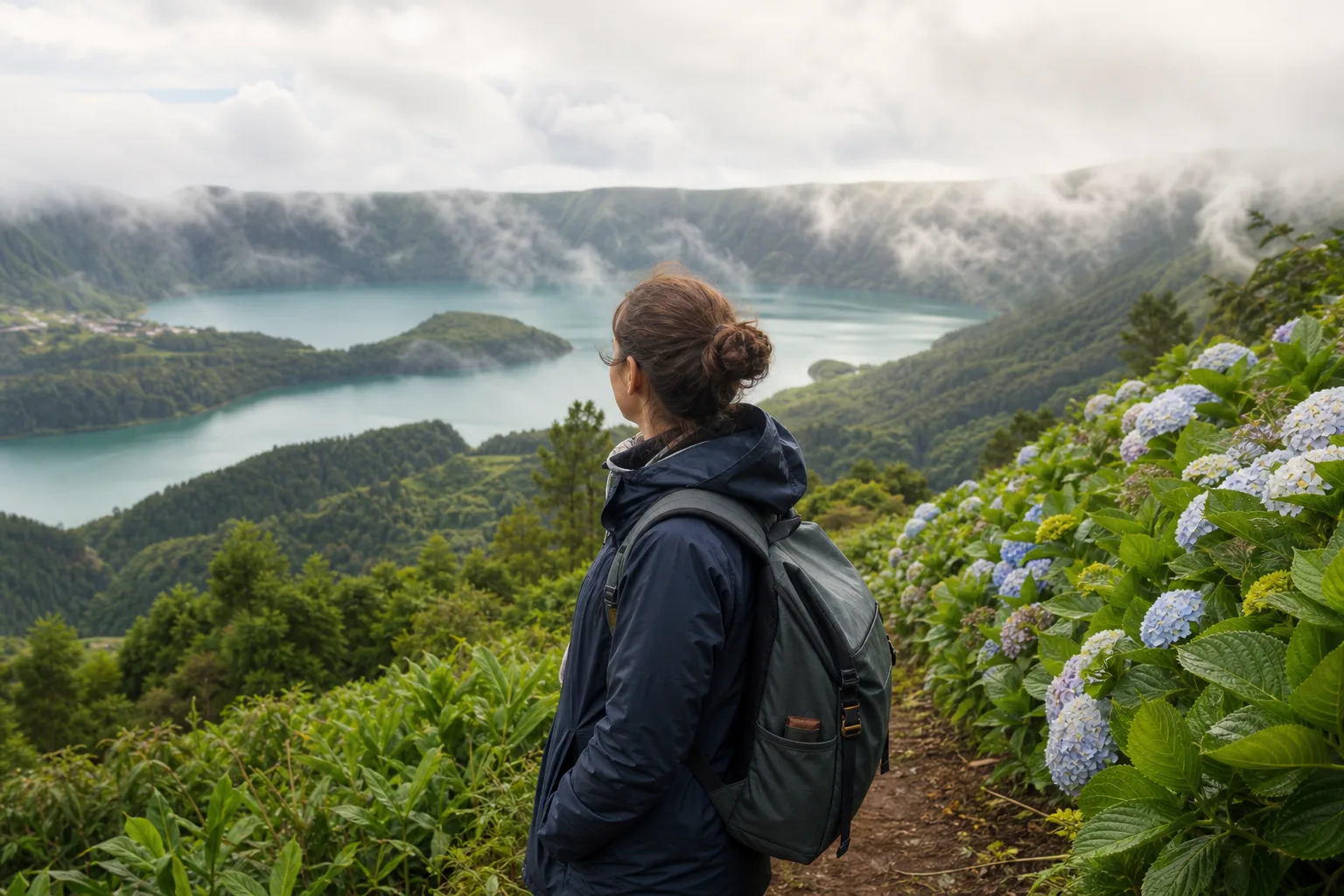
I landed in São Miguel with a light backpack, a waterproof jacket and only the first two nights booked. It was my first time in the Azores and I decided not to fill the journey of stages: I wanted to understand the rhythm of the islands before choosing where to go. Just outside the airport, the air knew about rain and ocean. The clouds ran low, much faster than my thoughts.
The first day plan included the viewpoint on Lagoa do Fogo. After twenty minutes of bus, however, the landscape had disappeared into a compact mist. Me and three other travelers came down the same, convinced that the wind would open a coil. It didn’t happen. We ended up laughing at our stubbornness and sharing a passage to a small trattoria along the way.
When the weather decides the route
At the Azores I learned early to read forecasts as a suggestion, not as a promise. Every morning I controlled wind, clouds and sea conditions, then prepared two alternatives: a high walk and a lower path between coasts, natural pools and countries. This little habit avoided frustrations and made me discover places I had not marked on the map.
The second attempt at Lagoa do Fogo was successful. The fog rose for a few minutes and the crater appeared below us, green and silent. I was with Marta, a Spanish girl known the day before, and with Tomás, a Czech photographer who traveled for months. Nobody spoke until the clouds covered everything again. That shared silence is one of the sharpest memories of the journey.
The lost ferry and a different night
I had planned to reach Pico, but the rough sea canceled the race I needed. For a few minutes I felt stuck: the accommodation was already paid and the next day I booked an excursion. At the port they explained to me calmly the options and I immediately wrote to the structure. The answer was simple: they would have moved the reservation without problems.
That night I did not plan to spend it in a family pension near the port. The owner prepared me an essential dinner and told me how, on the islands, it is normal to leave space at the time. At the table there were also two Italian hikers. We compared maps and the next morning we started together on the first available link. The unexpected had created a small group.
Travel alone without being isolated
I never needed to look for company at all costs. It was enough to choose accommodation with a common kitchen, stop talking after a path or ask for information without haste. Some days I spent it all alone, especially along the streets of ortensia and in the outdoor thermal baths. Others were born from a shared breakfast and ended up with an improvised dinner.
I was always carrying water, a hot layer, an external battery and an offline map. Before walking, I left the planned route to the structure. They were not gestures dictated by fear, but a way to move me serenity. Just this minimal organization allowed me to change my plan without feeling unproven.
What I have left
I came back with fewer pictures than I imagined and with more names on the diary. The Azores did not give me a perfect trip: they taught me not to measure a day only from the places visited. Sometimes the view remains hidden, the ferry does not leave and the rain forces to stop. It is right there that the journey changes direction and becomes really yours.